Working Parent vs Stay-at-Home Parent – Who Actually Sacrifices More Financially?
She’s juggling conference calls and daycare pickup. He’s home making lunches and tracking grocery budgets.
Each thinks the other has it easier.
But one thing’s certain: both are paying a price that rarely shows up in the family budget.
Team Paycheck or Team Play-dough – who sacrifices more?
Before you scroll, comment which side you’re on.
Then see if you still agree after reading this.
Because behind every family’s income statement is another one you’ll never find in QuickBooks – the emotional ledger of love, time, and trade-offs.
Related: The Family Money Secret No One Talks About (But Changes Everything)
The Hidden Economics of a Working Parent vs Stay-at-Home Parent
Money math first, because feelings aside, both sides make serious financial moves.
The Working Parent’s Bill:
Childcare costs in the U.S. range from $1,200 to $2,500 per month, per child, according to Care.com’s 2024 data. For many families, that is a second mortgage. A dual-income household with two children under five could spend nearly $30,000 a year just to be able to work.
Commuting and wardrobe costs add another $5,000 to $7,000 annually when you consider gas, parking, lunches, dry cleaning, and clothing. Those “invisible expenses” chip away at what looks like a solid salary on paper.
Then there’s the time tax. Every extra hour spent at work costs hours with family.. pickup, dinner, bedtime, sports games. Those moments don’t show up in the paycheck, but they’re felt deeply.
The Stay-at-Home Parent’s Bill:
The financial cost of staying home is harder to see, but it compounds quietly. A decade out of the workforce can erase more than $300,000 in lost retirement growth, according to Fidelity’s 2023 analysis. Even five years away from full-time work can significantly reduce lifetime earnings, making it harder to catch up later.
Staying home also affects Social Security credits. You need at least 40 quarters of paid work to qualify for full benefits. If you miss years in the workforce, your check may be smaller down the road.
Then there’s career momentum. A parent who leaves their job for a few years often re-enters at a lower position or salary. It can take years to rebuild. That’s the opportunity cost many families underestimate.
The Savings No One Counts
Now look at what the stay-at-home parent saves the family. Full-time childcare, after-school care, household management, cooking, cleaning, scheduling, and emotional labor. Salary.com’s 2024 estimate values a stay-at-home parent’s labor at over $184,000 annually if paid out as professional services.
That is the invisible income of the household CFO – the savings that keep the family functional.
Checkpoint
Compare childcare vs stay-home costs: Rocket Money Calculator
Track both incomes and household savings in one view: YNAB | Empower
Tools like YNAB or Empower help couples visualize all income and expenses together. You can see where money leaks, compare what you save by staying home, and plan with shared visibility.
The Emotional Cost of a Working Parent vs Stay-at-Home Parent
Money aside, here’s the real currency: identity, resentment, and guilt.
Identity – “Who am I without a paycheck?”
How Working Parents and Stay-at-Home Parents Experience Guilt Differently
Many stay-at-home parents quietly grieve their professional identity. Career titles fade, routines change, and the validation that once came from performance reviews or promotions is replaced by diaper changes and meal prep. It’s meaningful work, but often unseen.
Meanwhile, working parents wrestle with another kind of loss – presence. Missing bedtime stories, field trips, or school lunches can feel like failure. The question becomes not “who works harder,” but “who feels more invisible.”
Resentment – “Why does exhaustion look different when you’re paid for it?”
Working parents often feel unseen for their grind, while stay-at-home parents feel unseen because theirs isn’t on payroll. Both feel justified, both feel exhausted, and both crave acknowledgment.
Guilt – “Am I missing my kids or my potential?”
Every parent runs this equation in their mind. Each role comes with guilt, just in different currencies – time for money, or money for time.

My story plug:
“When he walks through the door, the vibe shifts. Not because of words, but because we live in two different kinds of exhaustion. Sometimes I think, if we swapped for just one week, how would we measure ‘getting things done’?”
Have you felt this tug-of-war in your own marriage? Drop your experience below – I read every one.
Power Couple Perspective >> Turning Division Into Strategy
Money shouldn’t divide; it should direct.
At Our Money Nest, a Power Couple means turning friction into systems that protect both partners.
- Weekly Check-Ins (15 minutes max)
Not a financial summit – a quick coffee chat.
Agenda: one win, one worry, and one shared goal.
Real Story: We use the TEAMS method. - Use Shared Dashboards
Apps like Empower or Monarch make it easy for both partners to see the full picture – no guessing, no gatekeeping.
Sometimes even something simple like a shared Sam’s Club account or grocery list app can prevent those “oh, add this” moments that turn into one person managing and the other just executing.
When you share tools, you share responsibility. That keeps communication equal, not transactional. - Think in Team Capital
All income, saved hours, and unpaid labor roll into the same mission: family security.
The family wins when both roles work toward the same outcome.. not when one is measured and the other is assumed. - Create a Family Contribution Snapshot
List everything that adds value – salary, home labor, childcare savings, emotional upkeep.
Seeing both sides quantified builds respect. It turns “my contribution” into “our progress.”
Build Systems That Actually Work (for Both of You)
Fairness isn’t a spreadsheet; it’s a system that keeps both partners safe, capable, and part of the plan.
Here’s how to make the money side of your teamwork simple, steady, and real.
- Stay on the Same Page
Forget permission language or one person running the budget.
Both partners should know what’s coming in, what’s going out, and what’s next. Use tools that update automatically – YNAB, Empower, or even a shared Google Sheet.
It’s not about control; it’s about calm. When both partners can see the numbers, nobody has to guess or hide.
Related: The 15-Minute Family Budget: A Foolproof System for Busy Parents - Create Real Safety, Not Just Savings
An emergency fund shouldn’t only cover the mortgage; it should cover peace of mind.
If something happens to one partner, could the other step in without panic?
Financial experts suggest saving three to six months of total household expenses, but families with children or a single income should aim higher. Include things like childcare, groceries, transportation, and temporary help.
Use Rocket Money to track subscriptions or find extra cash flow to build your safety net faster. - Pay Your Future Selves – Together
Instead of trying to assign a dollar sign to unpaid labor, focus on long-term security.
If one parent stays home, make sure both are building retirement savings.
A spousal IRA allows the working partner to contribute to retirement on behalf of the nonworking spouse.. one of the simplest, smartest ways to protect both futures.
According to Fidelity, even contributing $250 a month can grow to more than $100,000 in 20 years.
Tip: Compare IRA options and growth with the Fidelity Spousal IRA Guide or use the Empower Retirement Calculator to project your numbers.
Power Moves – Mindset Shift
Reframe the question.
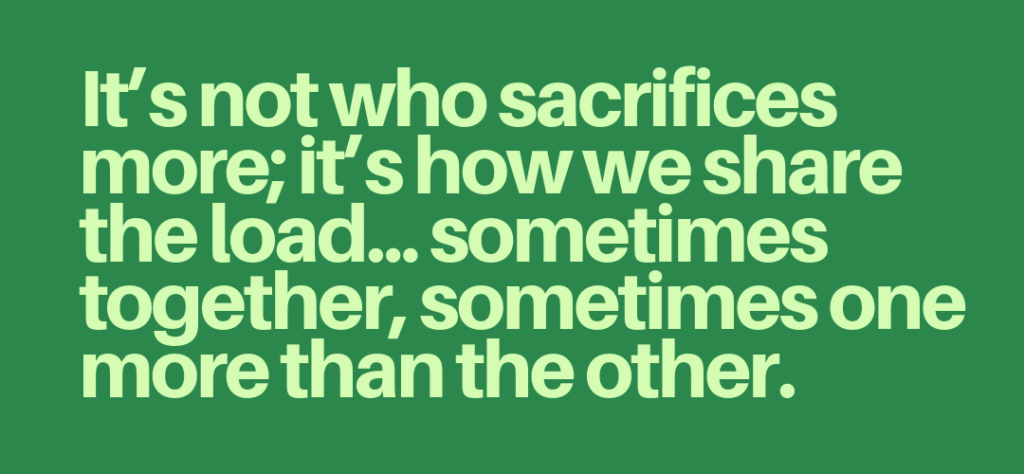
It’s not who sacrifices more; it’s how we share the load. Sometimes together, sometimes one more than the other. Isn’t that the real balance?
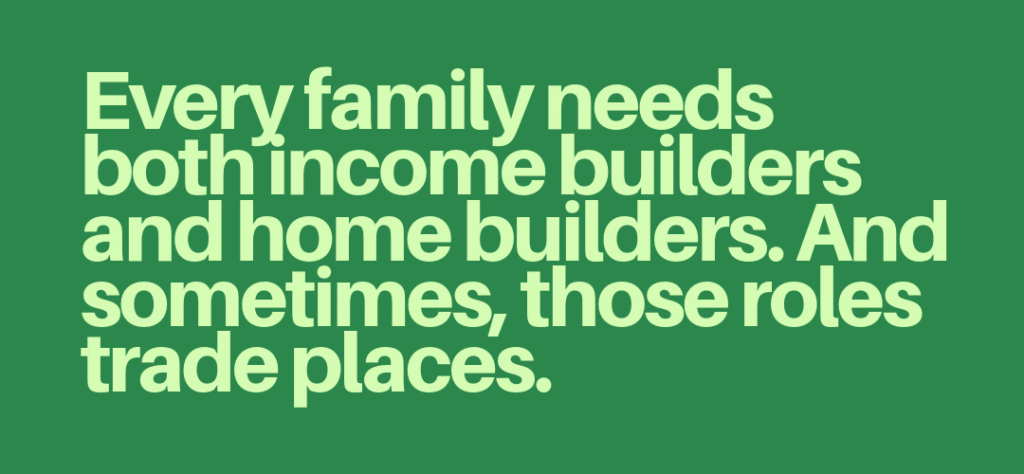
Every family needs both income builders and home builders. And sometimes, those roles trade places.
In healthy partnerships, balance is not about equality every day, but equity over time.
Mini Action Guide
Script 1: “I know we each work differently. Let’s talk about what feels unbalanced and what we both need.”
Script 2: “What would make your role feel more supported – time, help, or acknowledgment?”
Script 3: “Can we put numbers to the value we’re both adding? I want us to see it, not just feel it.”
The Legacy Lens
One day our kids will not remember who cooked more meals or who signed more paychecks.
They will remember who taught them love, discipline, and security – not who seemed to sacrifice the most.
They will measure sacrifice not in paychecks, but in presence.
Both sides of this debate are right. Working parents sacrifice time for stability. Stay-at-home parents sacrifice stability for time. Both choices are made out of love and both carry weight.
If your family is building wealth, freedom, and legacy together, you are already on the same team.

So now that you’ve seen both sides, which one feels heavier to you?
Comment below – I’m genuinely curious how families make this work.